Review · PRIVATE
Private Belfast Explore Like a Local
Belfast hits different when you have context. This private, hotel-pickup tour strings together the city’s top sights, from Victorian gardens to the murals on the Falls and Shankill. I love the guide-led pacing, and I love that you get hotel pickup so you spend less time figuring out routes and more time looking at the city.
You’ll also get real historical framing that is hard to piece together on your own, especially around the sites tied to the Troubles and the peace lines. One thing to consider: this is heavy material, and the guide’s tone can shape what you walk away feeling, so it helps to go in ready to ask questions and keep an open mind.
In This Review
- Key Things You’ll Notice on This Private Belfast Circuit
- Price and Logistics: What You’re Paying For
- Starting at the Botanic Gardens: Belfast’s Victorian Green Break
- Queen’s University Belfast and the “Queen’s Quarter” Story
- RISE Sculpture: A City Gateway You Can See From Anywhere
- Divis Tower: The Troubles, Up Close and Upward
- Peace Lines and Peace Walls: The Physical Version of History
- St Peter’s Cathedral on the Falls Road: Faith Built for a Growing City
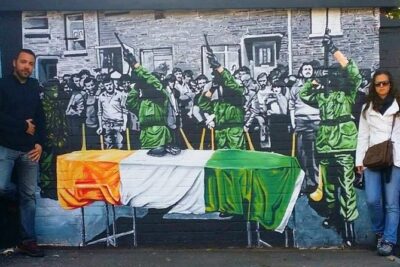
- Bobby Sands Mural: Hunger Strike History in One Iconic Photo Stop
- Clonard Martyrs Memorial Garden and the Sharp Edges of Commemoration
- Shankill Road: Loyalism, Working-Class Life, and Political Control
- Belfast Castle and the Cavehill Views You Can’t Miss
- Queen’s Square Albert Memorial Clock Tower: A Famous Leaning Landmark
- Big Fish and the Harbour Frame: How Belfast Tells Time
- Samson and Goliath Cranes, Then Titanic Quarter Photo Stops
- Crown Liquor Saloon: End the Day in a Real Victorian Gin Palace
- Extra Address and Mural Stops: How Belfast Changes by Street
- Should You Book This Private Belfast Explore Like a Local Tour?
- FAQ
- How long is the Private Belfast Explore Like a Local tour?
- What does the tour cost?
- Does the tour include hotel pickup and drop-off?
- Is this tour private and limited to my group?
- What language is the tour offered in?
- Are admission tickets included?
- Does the tour include anything at the Peace Wall?
Key Things You’ll Notice on This Private Belfast Circuit
- Hotel pickup and drop-off from central Belfast makes a 2.5 to 3 hour plan actually feel relaxed.
- A tightly planned route across many neighborhoods, including both sides of the political divide.
- Peace Wall time plus a chance to sign your name and leave a message of peace and hope.
- Murals at “maximum readability” distances, like the Bobby Sands mural and the Divis Street mural area.
- Ticketed stops at major landmarks, with a few notable exceptions (more on that later).
Other Belfast outings worth a compare
- Private Black Taxi Belfast City Tour
★ 5.0 · 2,188 reviews - 2 Hour Private Belfast Taxi Cab Tour of Troubles & Peace walls
★ 5.0 · 240 reviews - Private Political History & Murals Tour Belfast
★ 5.0 · 182 reviews - Giants Causeway & Antrim Coast Private Tour
★ 5.0 · 176 reviews
Price and Logistics: What You’re Paying For
At $638.11 per person for a 2 hours 40 minutes to 3 hours private tour, this is not a budget bus tour. You’re paying for two things that matter in a city like Belfast: local navigation and a guide who can explain what you’re seeing.
Your ride is private, in an air-conditioned vehicle, and the tour includes free hotel or cruise ship pickup and drop-off from central Belfast accommodations. You get a mobile ticket, and the tour runs in English. There’s also a “driver handles navigation” setup, which sounds minor until you’re actually in a maze of streets and traffic. In practice, it means you can keep your eyes up, not down at a map.
The itinerary mixes paid and free sights, so I’d treat the price as a bundle. Several stops include admission tickets, like the Botanic Gardens and Queen’s University Belfast, while a few headline photo spots are not included. If you want to add optional entry later, your guide can often help you plan your next step with what’s already on your radar.
Starting at the Botanic Gardens: Belfast’s Victorian Green Break
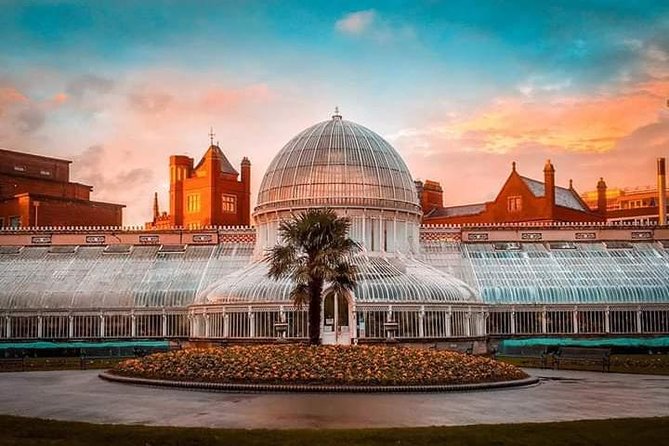
The Botanic Gardens (30 minutes, admission included) are a smart first stop because they reset your brain. Before the political murals and peace lines, you get Belfast’s Victorian-era horticulture story, including the setting Queen’s Quarter still feels rooted in.
The gardens were established in 1828 by the Belfast Botanic and Horticultural Society, sparked by public interest in botany and horticulture. What I’d watch for here is how many of today’s elements trace back to that original plant-collector ambition, including exotic tree species from the southern hemisphere that are still present.
Then comes the Palm House conservatory. It opened after the foundation stone was laid in 1839 and work finished in 1840, and it is known as an early example of a curvilinear cast iron glasshouse. Even if you’re not a plant person, this is one of those structures that makes Belfast feel like a real 19th-century city, not only a headline city.
Possible drawback: if you prefer faster, street-level action right away, 30 minutes in a garden might feel like a calm warm-up rather than the main event. I think that’s exactly why it works. It sets context so the later stops hit harder in a good way.
Queen’s University Belfast and the “Queen’s Quarter” Story
Next is Queen’s University Belfast (15 minutes, admission ticket included). This stop works best if you like connecting the dots between geography and identity. Queen’s University is the focal point of the Queen’s Quarter cultural district, and it sits right by the Botanic Gardens area.
You’ll get the timeline basics: the university was chartered in 1845 and opened in 1849 as Queen’s College, Belfast. The roots run even earlier to the Belfast Academical Institution founded in 1810, which remains as the Royal Belfast Academical Institution.
If you’re curious about architecture, the Lanyon Building is a named piece of the puzzle, designed by Sir Charles Lanyon. At opening it had 23 professors and 195 students, and some early students even took University of London examinations. That tiny detail matters because it shows this wasn’t a university built for local prestige only. It was plugged into wider education systems.
What you’ll feel here: Belfast has neighborhoods that are “about the past,” and neighborhoods that are “about institutions.” Queen’s Quarter is the institution side.
RISE Sculpture: A City Gateway You Can See From Anywhere
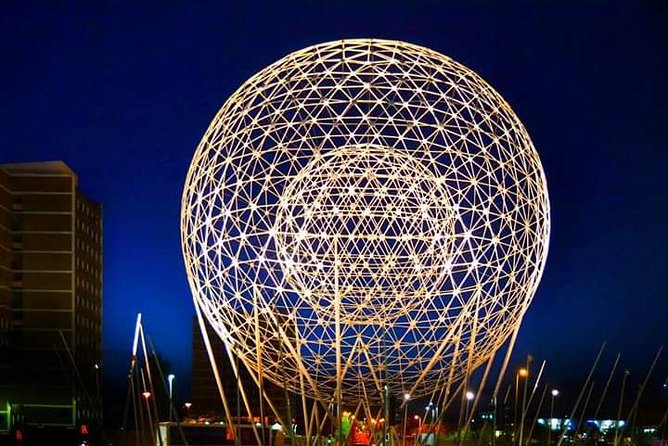
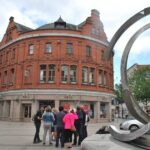
A quick stop at RISE, also called the Balls on the Falls, gives you a modern marker at the city’s gateway area. It’s a 37.5 meter high spherical metal sculpture by Wolfgang Buttress, constructed around the Broadway roundabout where huge traffic flows past daily.
This stop is short (10 minutes, admission ticket included), so treat it as a visual anchor. You’re in a city where physical landmarks help you remember where you are. RISE is that kind of landmark, and it also connects to how Belfast invests in public art and road infrastructure.
You’ll hear local nicknames like The Westicles, tied to its location in West Belfast. Whether you love modern sculpture or find it baffling, it helps you get spatial orientation fast. That matters once you start crossing toward the Falls Road and Shankill Road interface areas.
Still in Belfast? These are the next ones up:
- Titanic Belfast Entrance Ticket: Titanic Visitor Experience Including SS Nomadic
★ 4.5 · 3,698 reviews


Divis Tower: The Troubles, Up Close and Upward
Divis Tower is where the tour stops being about sightseeing and becomes about understanding. You’ll spend about 15 minutes here (admission ticket included), but this is one of the most information-dense stops on the route.
Divis Tower was built in 1966 as part of the Divis Flats complex, a vertical housing scheme that replaced older structures and became home to thousands of residents. The tower rises near the interface between Falls Road and Shankill Road, so it sits in that hard-to-ignore tension zone.
The story turns sharply during the Troubles. A British Army observation post was built on the roof in the 1970s, and access at the height of conflict could be helicopter-only. The tower is also tied to specific, tragic events:
- Patrick Rooney, a nine-year-old, was killed in August 1969 during Northern Ireland riots when shots from a Royal Ulster Constabulary armored car struck the flats. A later inquiry described the use of a Browning machine gun as wholly unjustifiable.
- In 1981, an Army sniper killed INLA sniper Emmanuel McClarnon from the top of Divis Tower, on a night tied to other deaths and hunger strike tensions.
After the IRA’s statement ending its armed campaign, the observation post was dismantled. In 2005 removal started, and later the top two floors were reinstated as residential properties, with a refurbishment program adding extra flats.
Consideration: this stop can feel emotionally heavy, even if you already know the basics. I recommend you take the “quiet moment” approach here. Look up, take in the scale, then let your guide do the explaining. Trying to multitask with photos can steal attention from the meaning.
Peace Lines and Peace Walls: The Physical Version of History
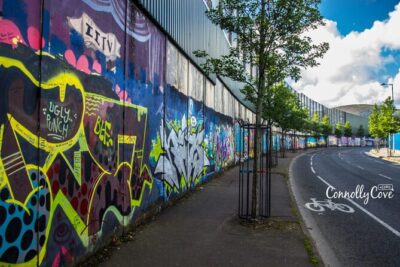
The Peace Wall and peace lines stops are where Belfast’s separation becomes visible in a way a map never will. You’ll be there about 30 minutes at the Peace Wall (admission ticket included), and the tour also includes peace line context and interface area explanation.
The core idea is simple: neighborhoods separated by barriers, with gates that can be locked at night. The walls can be up to six meters high in the way it is described on-site, and in other descriptions peace lines can be as high as eight meters, plus gates and controlled daylight access.
The “why” is also historical. Peace lines were first built in 1969 and were meant as temporary solutions, but they multiplied over time and became more permanent. The scale is huge: at least 59 listed peace lines in later counts, stretching over 21 miles, with most located in Belfast. Belfast’s interface structures cluster heavily in north and west areas, which are also the more disadvantaged parts of the city.
The tour’s format matters here. You aren’t just looking at barriers. You’re learning the human-level impact: how the streets can be quiet now, but the division still shapes everyday routes and feelings. This is also why the tour includes a chance to sign your name and leave a message of peace and hope. It turns “a hard topic” into “a shared statement,” which helps a lot at the end of such an intense stretch.
Drawback to be aware of: if you’re uncomfortable with politically charged settings, you might feel out of place at first. I’d still say it’s worth it, but approach with respect and keep your tone gentle.
St Peter’s Cathedral on the Falls Road: Faith Built for a Growing City
St Peter’s Cathedral (20 minutes, admission ticket included) brings you to the Falls Road side of Belfast’s religious and architectural story.
Construction began in the 1860s, and the church opened on 14 October 1866. Twin spires were added in 1886, giving the building a clear landmark silhouette. Materials and interior design tell the quality story too, including Scrabo sandstone with Scottish sandstone dressings and a hammer-beam ceiling.
This stop also carries institutional meaning. The cathedral is the Roman Catholic episcopal seat of the Bishop of Down and Connor. Later, in 1986 it was formally named the Cathedral Church of Down and Connor.
If you notice a choir connection, that’s not random. St Peter’s Schola Cantorum is part of the building’s identity, which is a nice reminder that Belfast culture is not only conflict. It’s also music, ceremony, and community life.
What might not work for everyone: the tour time is limited. You’ll want to absorb what you can, but you won’t get hours inside. If cathedral architecture is your main passion, consider extending with a separate visit.
Bobby Sands Mural: Hunger Strike History in One Iconic Photo Stop
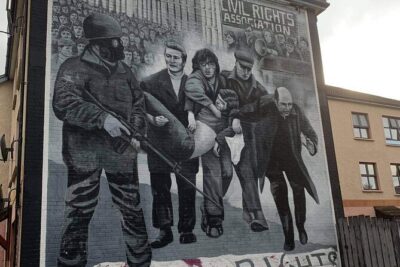
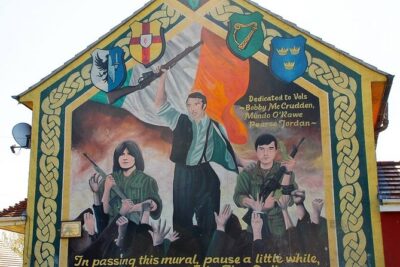
Two separate parts of the route focus on Bobby Sands and related mural spaces, including the main Bobby Sands mural area (10 minutes, admission ticket included) and later mural walls in the same general world of street art storytelling.
At the Bobby Sands mural photo stop, you’ll learn about Sands as leader of the 1981 hunger strike and his connection to HM Maze. The mural’s symbolism is built into the design. A phoenix rising from ashes points back to the 1916 Easter Rising, and the phoenix breaks the top chain. At the bottom, lark imagery splits the links, tied to ideas of pure voice and self-discovery. You’ll also see symbols like the harp with the absence of a crown.
This is one of those moments where context changes everything. Without it, it’s a striking face on a wall. With it, it becomes a map of meaning: what a community remembers, and what it wants to communicate.
Tip for making this stop worthwhile: take one clear photo, then spend the extra minute listening. The message sits in the details, and your guide can point them out in a way you might miss.
Clonard Martyrs Memorial Garden and the Sharp Edges of Commemoration
Clonard Martyrs (15 minutes, admission ticket included) is a memorial garden at Bombay Street in Clonard. It is described as the birthplace area of the Provisional IRA formed in 1969, and it also commemorates fallen volunteers and civilian casualties from the greater Clonard area, including deaths from the conflict years.
The design is intentionally stark. You’ll see black iron gates with black and red iron phoenix, and the garden is divided into three yards. The central yard features a black and white Celtic cross with an inscription, while a wall behind it includes granite plaques with volunteer imagery and additional memorial text. There are panels that also reference civilians murdered and list names and dates.
I like that the tour treats this as a stop about remembrance, not a spectacle. It is heavy, but it’s also orderly. There’s a structure to what you’re being asked to read and understand.
Consideration: if you want neutral, museum-style wording only, memorial gardens like this can feel direct. That’s not a flaw. It’s part of how history is actually held in Belfast.
Shankill Road: Loyalism, Working-Class Life, and Political Control
Shankill Road (20 minutes, admission ticket included) is presented as the heartland of Ulster loyalism. You’ll walk away with a geographic sense of west Belfast and how shops line the road while families and communities live in the branching side streets.
The tour also flags the security reality that shaped life during the Troubles. It notes that the bottom half of Shankill Road is controlled by the UDA (Ulster Defence Association), while the top half is controlled by the UVF (Ulster Volunteer Force).
This stop is short, so your takeaway should be orientation and context rather than a complete political analysis. The value is that you see both sides of the divide on the same day, so your brain stops treating the city as “two separate places.”
Practical tip: if you’re taking photos, keep it respectful. This is a lived-in street, not a theme park set.
Belfast Castle and the Cavehill Views You Can’t Miss
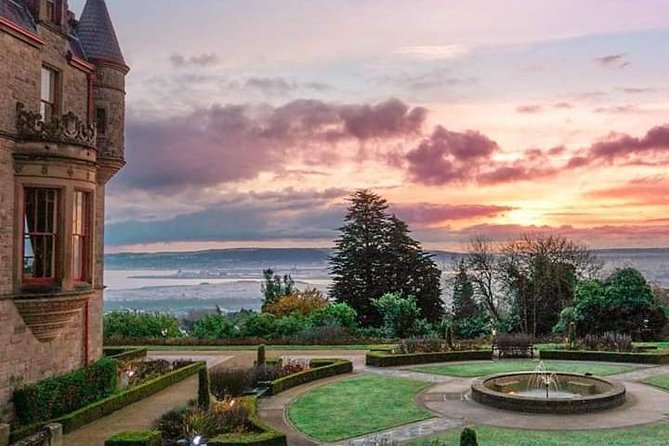
Belfast Castle (30 minutes, admission ticket not included) shifts the tone back toward everyday Belfast scenery. The castle sits on the slopes of Cavehill Country Park and gives unobstructed views across the city and toward Belfast Lough.
You’ll also hear the cat-themed garden idea, featuring nine cats made in sculpture, mosaic work, and manicured shrubbery. This is one of those local details that makes the experience feel human and a little playful after darker stops.
The castle’s deeper history is also part of the story. The earlier Norman castle from the late 12th century burned down in 1708. The current castle was built between 1811 and 1870 in a Scottish baronial style, designed by Charles Lanyon and his son, of the Lanyon, Lynn and Lanyon firm. Later, it was presented to the city in 1934 and reopened to the public in 1988 after refurbishment work.
A local curiosity called Napoleon’s Nose is linked to the Swift Gulliver’s Travels tradition.
Why the stop works: views create emotional processing time. Your brain needs a breather before the port area and shipbuilding era.
If you want to go inside: admission is not included here, so plan that decision if it matters to you.
Queen’s Square Albert Memorial Clock Tower: A Famous Leaning Landmark
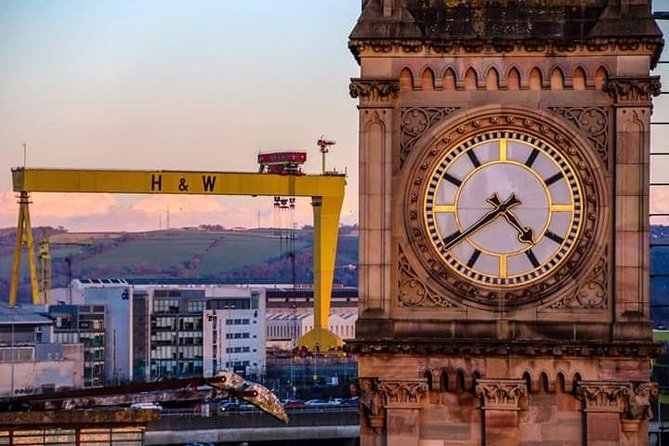
Albert Memorial Clock Tower (10 minutes, admission ticket included) is one of Belfast’s best-known landmarks. It was completed in 1869 and built from sandstone in a French and Italian Gothic mix style.
Here’s the fun fact that also shapes the feeling of this stop: the tower leans about four feet off perpendicular because it was built on wooden piles on marshy, reclaimed land around the River Farset. That’s why you might hear the phrase about the clock having the time and inclination.
There’s also a real-world reason for attention. The tower has flying buttresses with heraldic lions, a two-tonne bell inside, and a statue of Prince Albert in knightly robes on the western side. Construction cost details exist too, including public subscription funding.
It also carries conflict history in a smaller way, since it was damaged by a Provisional IRA bomb explosion outside nearby River House in January 1992. The surrounding area has since been regenerated, turning Queen’s Square and Custom’s House Square into more inviting public spaces with trees, fountains, and sculptures.
Big Fish and the Harbour Frame: How Belfast Tells Time
Big Fish, also called the Salmon of Knowledge (10 minutes, admission ticket included), is a printed ceramic mosaic sculpture by John Kindness. It is 10 meters long and installed on Donegall Quay near the Lagan Lookout and Custom House.
What you’re meant to notice is that each “scale” tells a story. Tudor times, newspaper headlines, and images linked to Belfast school children are part of the design. There’s even a time capsule built into the fish, storing information, images, and poetry.
This stop is short, but it’s a great bridge between old and new. After towers, walls, and memorial text, this feels like the city saying: we also make art that records everyday life.
Samson and Goliath Cranes, Then Titanic Quarter Photo Stops
The twin shipbuilding cranes, Samson and Goliath (10 minutes, admission ticket included), dominate the skyline in the Harland and Wolff shipyard area. They’re named after Biblical figures, built by the German engineering firm Krupp. Goliath was completed in 1969, and Samson in 1974, with heights of 96 meters and 106 meters.
I like that the tour doesn’t let you keep a common misconception. It specifically notes that the cranes did not host RMS Titanic because they were built later.
Next come quick photo stops around the Titanic Quarter:
- SS Nomadic photo opportunity (5 minutes, admission ticket not included), a White Star Line tender launched in Belfast in 1911, and described as the only White Star Line vessel in existence today.
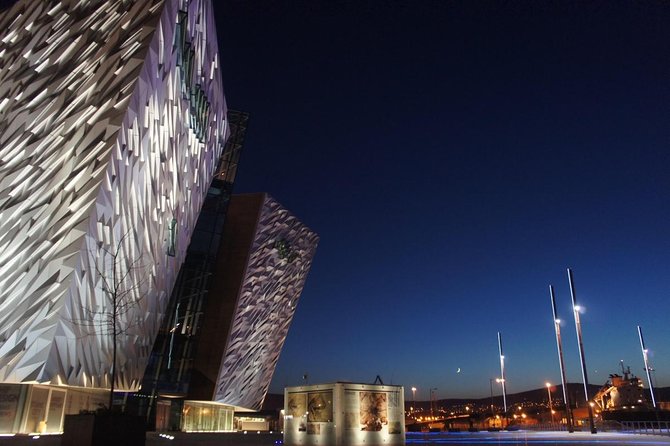
- Titanic Belfast photo opportunity (10 minutes, admission ticket not included), a major Titanic-themed attraction centered on land in Belfast Harbour.
How to use these stops well: decide what you actually want to pay for. Since admission is not included for these two, you can treat them as a taste and decide later if the museum time is worth it for you.
Crown Liquor Saloon: End the Day in a Real Victorian Gin Palace
Your tour ends at the Crown Liquor Saloon, also known as the Crown Bar (30 minutes, admission ticket included). This pub at Great Victoria Street is described as a standout example of a Victorian gin palace, refurbished in 1885 and known as one of Northern Ireland’s best-known pubs.
It’s a classic way to land the plane. You’ve spent hours on history that can feel intense. A pub stop gives you a social cooldown, and you can end with a pint without needing to plan a new transport step.
Extra Address and Mural Stops: How Belfast Changes by Street
There’s also time built in for murals beyond the main Bobby Sands area, including an International Mural Wall area on Divis Street (30 minutes, admission ticket included). Murals in Northern Ireland are treated as symbols that communicate political and religious identity, and the tour frames Belfast and Derry as hubs for major mural traditions since the 1970s.
You’ll hear that around 300 quality murals were estimated in Belfast in 2014, and that themes can range from hunger strikes to international solidarity messages and other conflict-linked events. There’s even a note about a Donald Trump mural, which helps you understand that Belfast street art is not only local.
The itinerary also includes a quick look at an affluent address area (5 minutes, admission ticket free) with huge mansions. That might sound random, but it serves a point: Belfast is not all murals and tension. It has strong class contrasts too.
Finally, Clonard Monastery (10 minutes, admission ticket included) adds another human detail. During the Belfast Blitz, more than 300 Protestants from nearby Shankill hid in the crypt. It is located off the Falls Road and associated with the Redemptorists religious order.
Those are the stops that keep the tour from becoming one-note. You see people, not only conflict.
Should You Book This Private Belfast Explore Like a Local Tour?
Book it if you want a private, efficient circuit that covers multiple Belfast “zones” in a single half-day. It’s especially worth it if you care about the Troubles, murals, and peace lines but do not want to do the hard work of researching each location separately. Hotel pickup plus a driver who handles navigation is a real quality-of-life upgrade in a city where distances do not feel huge, but street navigation can still be annoying.
Skip it, or consider it carefully, if you dislike politically tense settings or prefer a strictly neutral presentation. The tour handles heavy history and commemoration, and that can be emotionally intense. Also note that some major attractions in the Titanic Quarter and Belfast Castle have admission not included, so if you want full museum time, you may need an add-on plan.
If you match the mindset, this is a strong value-style day: many top sights, guided context that connects them, and a route that makes Belfast feel like one connected place, not disconnected postcodes.
FAQ
How long is the Private Belfast Explore Like a Local tour?
The tour runs about 2 hours 40 minutes to 3 hours.
What does the tour cost?
It costs $638.11 per person.
Does the tour include hotel pickup and drop-off?
Yes. There is free hotel or cruise ship pickup and drop-off from central Belfast accommodations. Airport pickup is not offered.
Is this tour private and limited to my group?
Yes. It is a private tour or activity, and only your group participates.
What language is the tour offered in?
The tour is offered in English.
Are admission tickets included?
Many stops include admission tickets, but not all. The tour data lists Belfast Castle, SS Nomadic, and Titanic Belfast as admission ticket not included.
Does the tour include anything at the Peace Wall?
Yes. It includes a peace line and peace wall experience where you can sign your name and leave a message of peace and hope.
Put up recently for Belfast
- Game of thrones -Giants causeway luxury tour 9 hrs 25 locations★ 5.0 · 1 review
- Private One-way Transfer From Belfast Int. Airport to Belfast★ 5.0 · 1 review
- CO2-Offset |Departure Belfast to BHD or BFS Airport by Luxury Van★ 5.0 · 1 review
- Enchanted Shores: Belfast to Giant’s Causeway★ 5.0 · 1 review
- Belfast’s Iconic Sites: A Self-Guided Audio Tour★ 5.0 · 1 review
- SAY NOTHING 1 hr express taxi tour – The Troubles living history★ 5.0 · 1 review
Private, compared.
2 Hour Private Belfast Taxi Cab Tour of Troubles & Peace walls
Read our review →
Private Political History & Murals Tour Belfast
Read our review →
Discover the City Walls – Small Group Public or Private Tour
Read our review →
Game of Thrones – Private Audi A6 tour with Richard the Wildling
Read our review →
Award Winning Exclusive 2 Hr Private Belfast Black Taxi Cab Tour
Read our review →