
Review · HISTORICAL TOURS
A History of Terror – Belfast City Centre Walking Tour
Belfast history hits hard, and it teaches fast. This 2 hour 30 minute city centre walk connects The Troubles story to street corners, with headsets so you can hear every detail without hovering.
I especially like how local guides turn big politics into specific moments you can actually picture, from the early unrest through the violence of 1971. Guides such as James and Mylie are often praised for balancing facts with human stories, and the tour ends at the Beacon of Hope with a look at peace and regeneration.
The main thing to consider is that this is an emotional subject. You will hear about bombs, deaths, and policing during the conflict, so expect sad moments even though the ending is hopeful.
In This Review
- Key Things That Make This Belfast Walk Worth It
- Where the Tour Starts: Belfast City Hall, Then the Timeline Clicks
- Donegall Place and the Ring of Steel: When a Shopping Street Turns Heavy
- Castle Lane in the Pedestrian Precinct: The Troubles at Street Level
- Spirit of Belfast, the Onion Rings, and the 1971 Spark
- Cathedral Quarter: Street Art Today, Peace-Building Stories Tomorrow
- Ann Street and the Police Station: How Control Changed Over Time
- Beacon of Hope on the River Lagan: Ending With Resilience You Can See
- Price and Value: Why $36.06 Feels Fair for This Much Ground
- Pacing, Comfort, and What to Wear in Belfast Weather
- The Guides Make the Difference: Facts, Tone, and Human Stories
- Who Should Book This Belfast History Walk
- Should You Book A History of Terror, Belfast City Centre Walking Tour?
- FAQ
- How much does the Belfast City Centre walking tour cost?
- How long is the tour?
- Where does the tour start and end?
- What is included in the price?
- How much walking is involved?
- What language is the tour offered in?
- What is the minimum age?
- Is the tour limited to a small group?
- What should I do about weather?
- If I want to tell you what my travel style is, can you recommend it?
Key Things That Make This Belfast Walk Worth It
- Headsets included, so you can hear clearly while you stay with the group
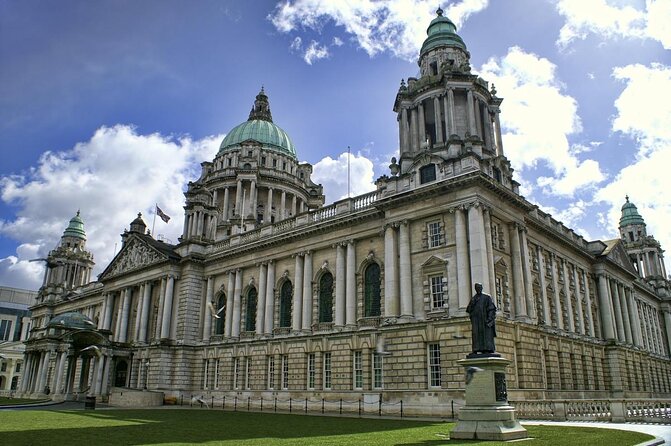
- Belfast City Hall sets the timeline, including why troubles began in the late 1960s
- Donegall Place and the 1971 nightclub bombing, with context on the Ring of Steel
- Spirit of Belfast, the public artwork nicknamed the Onion Rings, tied to events starting in 1971
- Cathedral Quarter storytelling, mixing street art and nightlife today with the path to peace
- River Lagan finish at Beacon of Hope, comparing Belfast then and now
More of the history, walked through:
- Private Political History & Murals Tour Belfast
★ 5.0 · 182 reviews - Belfast Political/history/troubles private taxi/cab tour
★ 5.0 · 69 reviews - Belfast Walking Tour: City Centre History, Troubles & Stories
★ 5.0 · 39 reviews - 1 Hour Express Belfast Taxi/Cab Tour History, Murals, Troubles
★ 5.0 · 17 reviews
Where the Tour Starts: Belfast City Hall, Then the Timeline Clicks
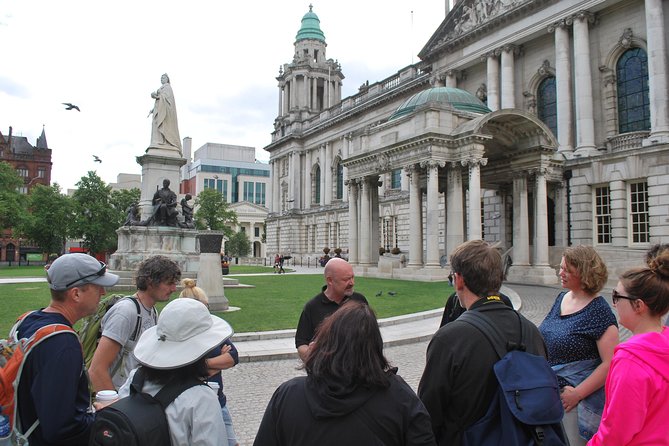
The tour begins at Belfast City Hall, meeting at Donegall Square North (near Belfast BT1 5GS). The first stop matters because it frames everything that comes after. You do not start with random scary scenes. You start with the relationship between Britain and Ireland over centuries, then you get a clear setup for why The Troubles took shape in the late 1960s.
This kind of opening is what makes the rest of the walk feel coherent. Once you know the background, the later stops are easier to follow, and the guide can connect political events to street-level consequences. It also helps that this part is outdoors in the city centre, where you can settle into the pacing right away.
A small practical tip: even though the route is flat, still plan to stand for short periods. This is a “stop and listen” walk as much as a “stroll.” If you like to move constantly, you might find the rhythm slower than you expected.
Donegall Place and the Ring of Steel: When a Shopping Street Turns Heavy
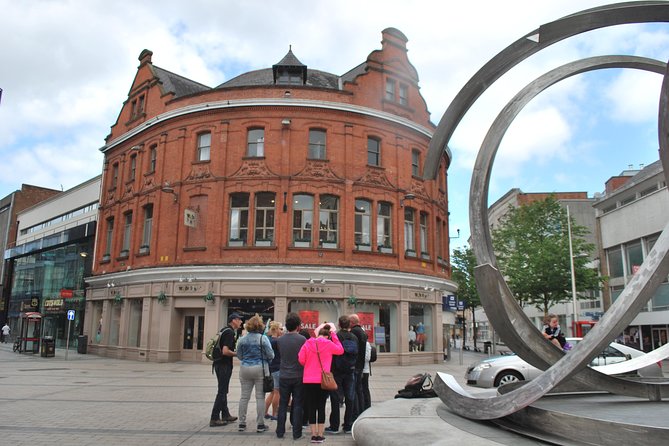
From Belfast City Hall you head to Donegall Place, Belfast’s main shopping street. On the surface, it looks like lots of other British and Irish city centres: shops, foot traffic, everyday life. But this stop is about how the past sits under the routine.
Your guide explains a 1971 bomb attack on a nightclub on this street and what happened afterward. Then you hear how security responses took a specific form that became known as the Ring of Steel. The phrase might sound abstract until you connect it to the city you are walking through, where people had to live with fear, restrictions, and uncertainty.
What I like about this stop for your first-time visit is that it shows something important: Belfast’s key places are not museum dioramas. They are still active streets. The guide helps you read the city like a timeline, not just a map.
Emotional note: this part can land hard. You will be near a place tied to loss of life, so it helps to pace yourself. If you tend to get overwhelmed by heavy stories, give your body a moment to reset between stops.
Castle Lane in the Pedestrian Precinct: The Troubles at Street Level
Next comes Castle Lane, in the heart of Belfast’s pedestrian precinct. This is one of those parts of the walk where the surroundings feel modern and comfortable, which makes the story feel even sharper.
Here, the guide talks about the realities of daily life at the height of the Troubles, including details of an incident that still stays with people. The tour does not treat these locations as distant history. It emphasizes how fear and conflict changed how people moved, worked, and felt in their own neighbourhoods.
A practical takeaway for you: look around during this stop. When you know the story behind the street, you start noticing how spaces are used, where people might have gathered, and how normal movement can become dangerous depending on the time period.
If you want to take photos, do it quickly and respectfully. This is a memorial-minded walk more than a sightseeing photo safari.
Spirit of Belfast, the Onion Rings, and the 1971 Spark
Then you reach the Spirit of Belfast artwork. If you have seen pictures online, you will recognize it immediately by its nickname: the Onion Rings. The artwork is meant to evoke resilience, and the guide uses it to connect art, memory, and public emotion.
Your guide talks about a series of events that started in a bar nearby in 1971, acting as a catalyst that helped push Northern Ireland into an escalating spiral of violence. Standing in the shadow of a piece of public art makes the story feel less like a lesson and more like a lived experience that the city is still carrying.
This stop is a good “gear shift.” You have heard multiple tragic incidents by now. Here, you get a chance to step back and see how Belfast marks resilience in the open, not just behind closed doors.
One more reason I like it for your trip: it is memorable. Even if you forget some dates, you will remember the image of the artwork and the way the guide tied it to the escalation.
More Walking Tours in Belfast

Cathedral Quarter: Street Art Today, Peace-Building Stories Tomorrow
The walk continues into the Cathedral Quarter, where Belfast shows off its present-day energy. The area has been newly regenerated and it is at the heart of the cultural and nightlife district. You will also notice street art and lively alleyways that encourage you to slow down.
But the guide keeps the focus on the past. You hear stories tied to more significant events while also discussing the beginnings of the path to peace. The result is that you do not just see a trendy district. You understand why this place had to change, and how the hope of peace grew out of long pressure, grief, and negotiation.
I like this stop because it is balanced. You get context for the present without pretending the past disappeared. If you plan to come back after the tour, this is the perfect place to do it with better eyes. You will know what you are walking past.
If you are travelling with someone who finds The Troubles too heavy, this is often the stop that helps them feel the purpose of the tour: the ending is not denial. It is acknowledgement plus progress.
Ann Street and the Police Station: How Control Changed Over Time
Next is Ann Street, where you stand beside the largest police station in Belfast. This is where the tour turns toward how policing worked during The Troubles, and then how things changed after the peace agreement.
The guide also discusses a potential modern pressure point: the impact of Brexit on borders. You do not get a policy lecture. You get a sense that the political story keeps reshaping everyday reality, just in different ways.
For you, this is one of the most practical stops. It helps connect past and present. Security, identity, and borders are not only historical topics here. They still affect how people think about place and belonging.
When you are ready, glance around the street layout and the buildings. Even without extra explanation, you can often feel how institutions and public space are connected.
Beacon of Hope on the River Lagan: Ending With Resilience You Can See
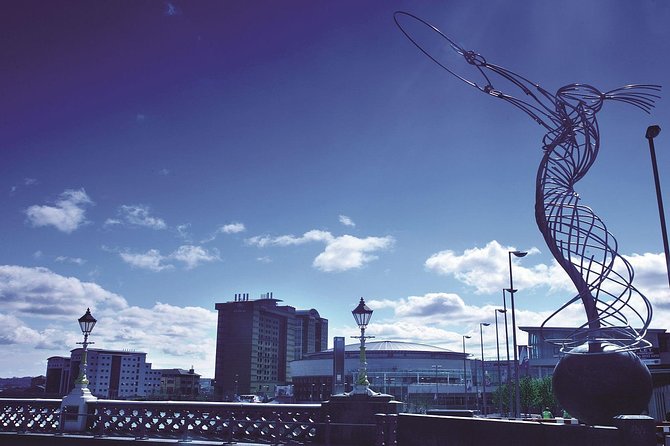
The tour finishes at the Beacon of Hope on the waterfront along the River Lagan, ending near Oxford Street (you are then about a 5 minute walk back to the city hall area). The guide compares Belfast today with one of its darkest periods, and explains how Belfast reached a fragile peace.
This is not a victory lap. The language stays grounded. You also hear discussion of what the future may hold, which matters because the Troubles are not just something that happened then. They shaped the city and they still influence political life.
I like this ending because it gives you closure without turning the story into propaganda. You leave with a clearer understanding and a visual reminder that resilience can be built into public spaces.
If you have extra time after the tour, take a slow walk along the river. It is a good way to let the heavy parts settle before you re-enter normal city noise.
Price and Value: Why $36.06 Feels Fair for This Much Ground
The price is $36.06 per person, and the tour runs about 2 hours 30 minutes. For that cost, you get a local guide plus headsets, which is a big quality upgrade on tours where you have to strain to hear.
You also get a lot of “coverage” for the time:
- Multiple major city centre locations
- A guided explanation that ties events to places
- Clear listening support with headsets
- A route that is only about 1.5 miles and mostly flat, with no hills or steps
The value also comes from the structure. You are not just walking past plaques. The guide connects why the conflict started, what happened in 1971, how policing worked, and where peace efforts brought Belfast afterward. That kind of storytelling costs real time and expertise.
One caution: this is not a fast-moving highlights tour. If you want constant walking and lots of photo stops, you might feel the pacing is more “history lesson outdoors” than “sightseeing sprint.”
Pacing, Comfort, and What to Wear in Belfast Weather
The tour involves moderate walking and takes place in the Belfast city centre, which is flat. That is great if you prefer easy footing. Still, comfortable shoes are a must because you will spend time standing at stops.
The operator recommends:
- A waterproof jacket, just in case of showers
- Warm clothing in winter months
- Check the forecast even though the tour runs in poor conditions
Also, the group size is capped at 25 travelers, which keeps things manageable, especially when listening to a guide.
One more practical angle from the included gear: headsets help you stay with the group without craning your neck toward the speaker. If you have hearing sensitivity, sit where you can hear clearly from your headset and avoid wandering far from the guide during explanations.
The Guides Make the Difference: Facts, Tone, and Human Stories
Across the tour, the best praise points to the same theme: the guides connect emotion to detail, while trying to keep the framing balanced and fact-focused.
You will hear guides described as funny and engaging, but also serious when the moment demands it. Some guides bring first-hand perspective because they lived through parts of the Troubles. Names that come up include James, Mylie, Anne, Roisin, Chris, and Rory. Even with different backgrounds and accents, the common strength is storytelling that explains how politics became everyday fear.
That matters because The Troubles are complicated. When the guide is skilled, you get clarity instead of propaganda. When the guide is less clear, you can feel lost. That is why the headsets and group control matter so much on this particular route.
If you like tours that leave you with both context and empathy, this is a strong match.
Who Should Book This Belfast History Walk
This tour is best for you if:
- You want to understand The Troubles through Belfast’s streets, not just a textbook
- You prefer a guided narrative that connects past events to present Belfast
- You want history that ends with a look at peace and what resilience means today
It can be a tough pick if:
- You dislike heavy topics and do not want to hear about bombings and deaths
- You are looking for a carefree, entertainment-first city stroll
A good time to do it is early in your visit, because it helps you read the city for the rest of the trip. By the time you wander the Cathedral Quarter on your own, you will know what stories you are stepping into.
Should You Book A History of Terror, Belfast City Centre Walking Tour?
My take: Yes, book it if you care about understanding Belfast instead of just visiting it. For $36.06, you get strong value, practical listening support with headsets, and a route that covers key spaces tied to the conflict and the peace that followed. The pacing is steady, the walking is manageable at about 1.5 miles, and the flat city centre makes it easier to enjoy.
Skip it or choose a lighter alternative if you are not ready for emotional stories. This walk deals directly with tragic events, and it spends real time on explanations rather than quick photo moments.
If you want your Belfast trip to make sense, start here, then use the rest of your day to explore with more informed eyes.
FAQ
How much does the Belfast City Centre walking tour cost?
The tour costs $36.06 per person.
How long is the tour?
It runs about 2 hours 30 minutes.
Where does the tour start and end?
It starts at Belfast City Hall, Donegall Square North, Belfast BT1 5GS, UK. It ends at Oxford Street, Belfast BT1 3NB, near the Beacon of Hope, and it is about a 5 minute walk back to city hall.
What is included in the price?
You get a local guide and headsets so you can hear the guide clearly.
How much walking is involved?
There is moderate walking on a flat route. The total distance is about 1.5 miles, with no hills or steps in the city centre.
What language is the tour offered in?
The tour is offered in English.
What is the minimum age?
The minimum age is 12 years.
Is the tour limited to a small group?
Yes. The maximum group size is 25 travelers.
What should I do about weather?
The tour will take place regardless of the weather, but it is recommended to check the forecast. A waterproof jacket and warm clothing in winter are suggested. If the experience is canceled due to poor weather, you will be offered a different date or a full refund.
If I want to tell you what my travel style is, can you recommend it?
Yes. Tell me your pace (easy walking or lots of movement) and how you feel about heavy history, and I’ll help you decide if this is the right fit for your Belfast day.
Put up recently for Belfast
- Game of thrones -Giants causeway luxury tour 9 hrs 25 locations★ 5.0 · 1 review
- Private One-way Transfer From Belfast Int. Airport to Belfast★ 5.0 · 1 review
- CO2-Offset |Departure Belfast to BHD or BFS Airport by Luxury Van★ 5.0 · 1 review
- Enchanted Shores: Belfast to Giant’s Causeway★ 5.0 · 1 review
- SAY NOTHING 1 hr express taxi tour – The Troubles living history★ 5.0 · 1 review
- Belfast Troubles Walking Tour: A Journey Through History★ 5.0 · 1 review
Historical Tours, compared.
Private Political History & Murals Tour Belfast
Read our review →
Belfast Political/history/troubles private taxi/cab tour
Read our review →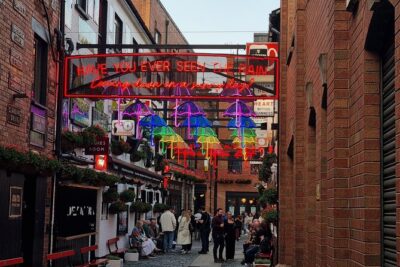
Belfast Walking Tour: City Centre History, Troubles & Stories
Read our review →
1 Hour Express Belfast Taxi/Cab Tour History, Murals, Troubles
Read our review →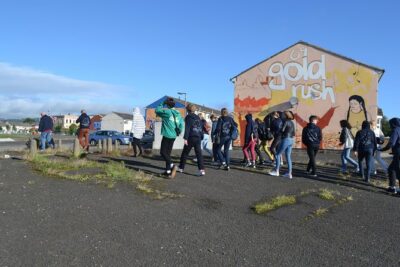
Belfast political history and mural unique private 90 min tour
Read our review →
Belfast by the Glass: alternative history of Belfast, sip by sip.
Read our review →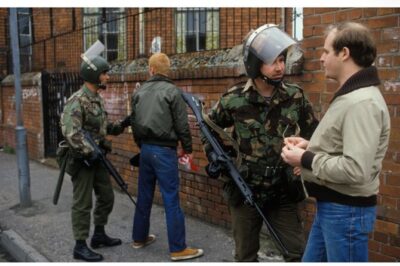
2 Hour Terror and Mural History Belfast taxi Private Tour
Read our review →Browse the lists this tour appears in