
Review · MURAL TOURS
IRA Troubles Conflict Private Tour Museum Graves Murals and Political Analysis
Belfast history has teeth. This private 3-hour tour takes you from Falls Road murals to the Peace Walls, then to memorials and a museum tied to the Troubles, with a strong Irish Republican lens and plenty of time for questions.
I love the access angle, especially the stop at a private museum that is not usually open to the public, plus the chance to talk things through with the guide as you go. I also like the mix of street-level visuals and grounded context, from political murals painted by ex-prisoners to the cemetery and hunger strike storylines.
One possible drawback is that the narrative is intentionally Irish Republican in framing, so you will hear Loyalist or British roles mostly as part of that story, not as an equal back-and-forth debate. Also, the emotional stops, especially Milltown Cemetery and memorial gardens, are heavy, and the schedule packs a lot in.
In This Review
- Key highlights I think you will care about
- A Belfast Tour Built Around Political Reality, Not Just Photos
- 3 Hours, Private Transport, and Pickup That Actually Sets You Up
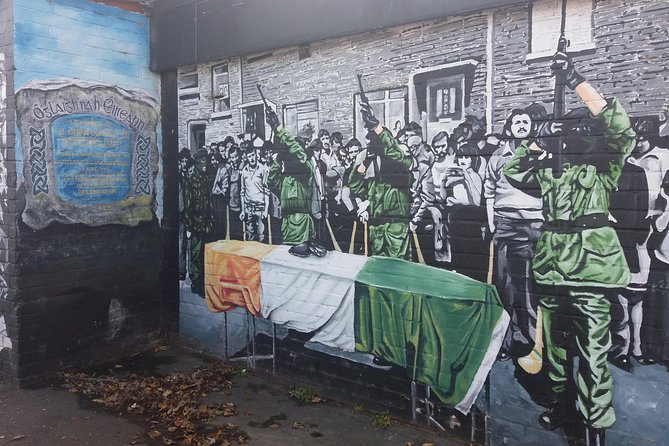
- International Mural Wall and Divis Street, Where the Story Is Painted
- Peace Walls Up Close, Including the Peace Message You Write
- Shankill Road Murals, Loyalist Power, and How the Interface Feels
- Clonard Martyrs Memorial Garden, D Company, and the Cost of the Conflict
- Milltown Cemetery and Bobby Sands, Where Hunger Strike History Gets Human
- Bobby Sands Murals and the Blanket and Dirty Protests
- Eileen Hickey Irish Republican History Museum, Ex-Prisoners, and Museum Time Limits
- Clonard Monastery and the Interface Between Falls and Shankill
- Divis Tower and Ballymurphy Road, Concrete, Names, and Specific Murals
- Pricing and Value, What You Get for $255.50
- Who This Tour Fits Best (and Who Might Want a Different Angle)
- Final Verdict: Should You Book?
- FAQ
- How long is the tour?
- What does the price include?
- Is hotel pickup included?
- What are the museum hours, and what if it is closed?
- Is this a private tour or shared group?
- Will I have time to write on the Peace Wall?
- Are tips included?
Key highlights I think you will care about
- Private access, more questions than you get on big bus tours, with the freedom to ask follow-ups along the route
- Private museum time window and a smart backup plan if it is closed, shifting focus to Ballymurphy murals
- Peace Wall ritual where you sign your name and write a message of peace
- Memorial stops that explain why they matter, including Clonard Martyrs and D Company remembrance
- Murals with names and specific events, not just general photos of walls
- Hands-on detail including seeing and handling plastic and rubber bullets used by British Crown forces
More gable walls and painted ends:
- Belfast’s Political Mural Taxi Tour
★ 5.0 · 1,180 reviews - Famous 1.5 hour Belfast Murals Tour
★ 5.0 · 477 reviews - Belfast Murals Taxi Tour
★ 5.0 · 341 reviews - 2 Hour Private Belfast Taxi Cab Tour of Troubles & Peace walls
★ 5.0 · 240 reviews
A Belfast Tour Built Around Political Reality, Not Just Photos
If you want Belfast as a living argument, not a postcard, this is the right kind of tour. You are moving through interface areas where everyday life still sits beside old dividing lines, and the guide keeps connecting what you see to how the conflict evolved and what the peace process has (and has not) changed.
What makes it work is the pacing. It is only about three hours, but it is not a frantic grab-bag. Instead, each stop acts like a chapter, murals first, barriers next, then the memorials and museum that explain the human cost.
3 Hours, Private Transport, and Pickup That Actually Sets You Up
You are on a private tour, meaning it is just your group, not a mixed crowd. That matters in places like this, where you will want to ask questions freely, stop for photos without rushing, and listen without competing with other chatter.
Pickup is offered. There is free pickup from a central Leonardo hotel location, and extra charges for other pickup points. The vehicle is air-conditioned, and the tour includes private transportation with the driver handling navigation, so you can look out the windows instead of playing map games.
International Mural Wall and Divis Street, Where the Story Is Painted
The first stop sets the tone. You head toward the Falls Road area, and the guide frames the Troubles from an Irish Republican perspective, then connects it to today’s peace process and the political thinking behind it. This is not just background, it is the lens you will carry for the rest of the tour.
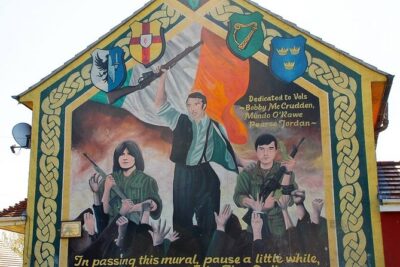
You will spend time at politically charged murals tied to the division of Belfast and painted by ex-prisoners (POWs). The murals are not neutral art, and that is the point. They are visual messaging, history on brick, and the guide helps you read them instead of just photographing them.
A practical consideration: because you are starting with visuals, come ready to slow down. If you rush through murals like they are Instagram stops, you will miss the narrative the guide is building.
Peace Walls Up Close, Including the Peace Message You Write
Next comes the Peace Wall, one of the separation barriers that still divides predominantly Catholic and Republican areas from predominantly Protestant and Unionist areas. This is where you see the conflict’s afterlife in concrete form, not in books.
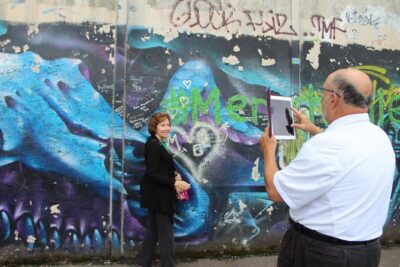
You will visit both sides, and the guide explains why the barriers were built. You will also do something small but memorable: sign your name and write a message of peace on the wall. It is a quick act, but it forces you to think about what peace means in a place where physical boundaries still exist.
One detail that helps your understanding is the timing story the guide shares: the first walls went up in 1969 after sectarian riots, the barriers proved effective, and they never fully came down. The tour data also notes that around one-third of the walls appeared after 1994, when the IRA declared an effective ceasefire. That is a useful reality check on the word peace.
More indoor stops for a wet day:



Shankill Road Murals, Loyalist Power, and How the Interface Feels
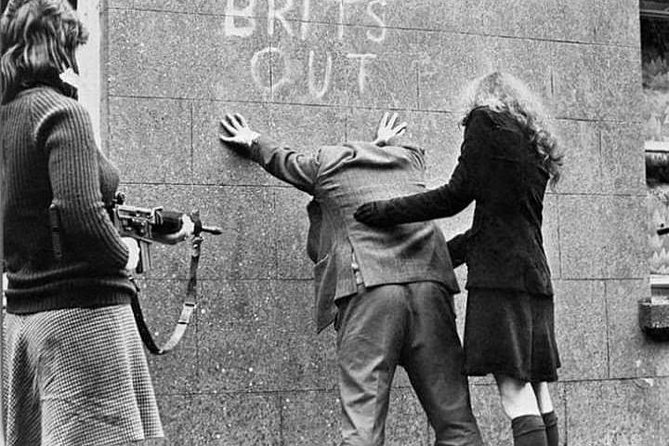
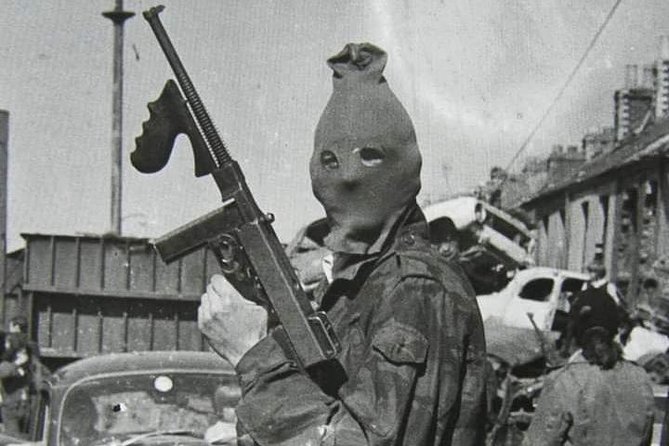
Then you swing to the Shankill Road, the heartland of Ulster Loyalism. Here, the guide explains how Loyalism developed and evolved during the conflict, and you get time for photos of murals featuring masked figures associated with loyalist paramilitary groups.
This stop is valuable because it is not just a wall you pass. You are learning what the murals are signaling and why the area is considered a loyalist stronghold. If you are trying to understand how parallel narratives hardened on each side, this is one of the clearest stops on the route.
Just be ready for the visual intensity. Even if you know the broad history, seeing the messaging up close gives it weight.
Clonard Martyrs Memorial Garden, D Company, and the Cost of the Conflict
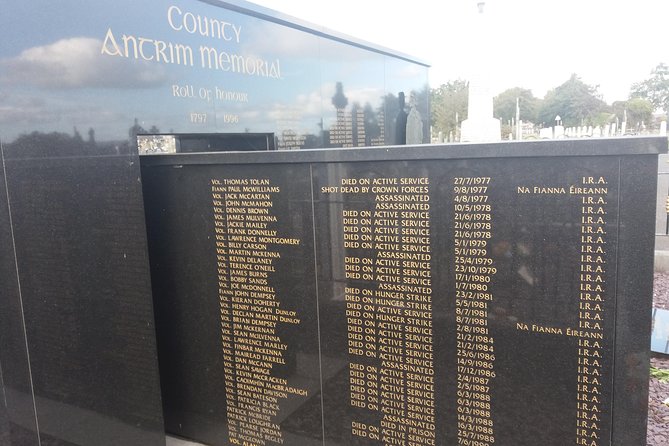
Clonard is where the tour turns from street politics to memorial politics. At the Clonard Martyrs Memorial Garden on Bombay Street, you will learn about fallen volunteers and civilian casualties from the wider Clonard area, with the garden commissioned by the Greater Clonard Ex-Prisoners’ Association.
The garden is described as a space with iron gates featuring a rising iron phoenix in black and red, plus the idea of rising from ashes and the Provisionals. Inside, the garden is divided into three separate yards, with a central yard that includes a black and white Celtic cross and plaques that list names and categories of deaths.
You will also hear about commemorations tied to dates around 11 March, plus annual marches connected to the memorial. The guide explains why these lists and plaques matter to families and to the political memory of a community.
This is one of the stops where the tour schedule makes a difference. It is not just a quick glance. You get enough time to understand what you are looking at, including the garden’s message that civilians and prisoners are being remembered together in one memorial structure.
Milltown Cemetery and Bobby Sands, Where Hunger Strike History Gets Human
Milltown Cemetery is the kind of place that changes the temperature in your head. You visit the Republican Plot, tied to Republican patriot dead, and the tour specifically points to the burial of Bobby Gerard Sands, who died on hunger strike while imprisoned at HM Prison Maze after being sentenced for firearms possession.
You also learn the context of the 1981 hunger strike, including the protest against removal of Special Category Status, and the detail that Sands was elected MP at the time of his death on hunger strike after 66 days. Those facts are not presented as trivia. They are used to explain why the hunger strike became a defining moment in republican political life.
The tour data also mentions that work by the National Graves Association, Belfast, includes multiple republican plots and graves of IRA volunteers killed in the 1920s and during the Northern Campaign in the 1940s. Graves are marked with the Red Hand symbol, and there is a New Republican Plot that includes remains of many IRA volunteers, including Óglach Mairéad Farrell.
If you are short on emotional bandwidth, build in a pause here. This is where you may feel the most impact.
Bobby Sands Murals and the Blanket and Dirty Protests
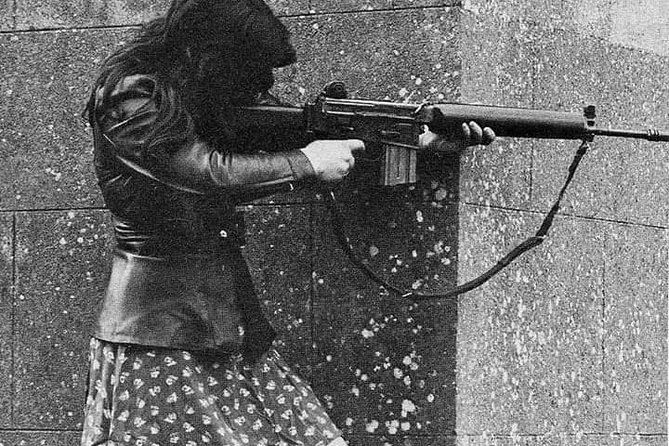
After the cemetery, you will see Bobby Sands murals again in the heartland areas, plus related “Garden of Remembrance” type stops tied to D Company, also noted as the 2nd Battalion Belfast Brigade. This part of the tour focuses on how the IRA fought a long guerrilla war and it points to specific events such as the Battle of the Falls (1970) and the Falls Road Massacre (1920).
You also get time tied to hunger strike themes, including the blanket and dirty protests, which are presented as key steps that led into the 1981 hunger strikes. The tour notes also mention seeing photos of 12 of the 22 hunger strikers in this area, which helps you connect faces to names rather than keeping it abstract.
This section is especially good if you are the type of visitor who wants to tie political decisions to real bodies and real consequences.
Eileen Hickey Irish Republican History Museum, Ex-Prisoners, and Museum Time Limits
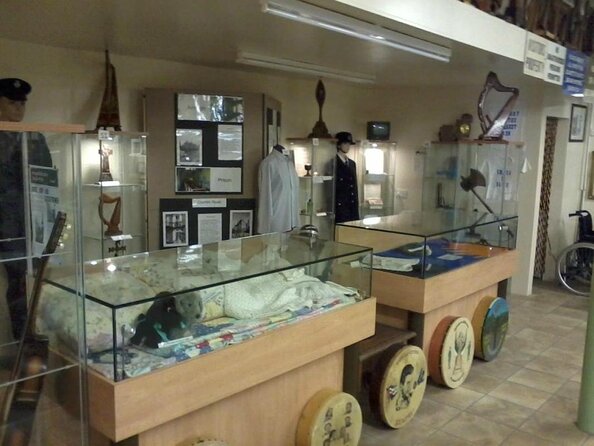
The museum stop is a major value add. The tour includes time at the Irish Republican History Museum, also identified as the Eileen Hickey Irish Republican History Museum, and the guide is described as an Irish history specialist.
The museum is not open all week. The tour data states it only opens 10-2 Tuesday through Saturday. When it is closed, you shift focus and the guide will show you around Ballymurphy instead.
Inside the museum, you will learn about resistance and the struggle against British occupation across a long span of Irish history, and you will meet ex-prisoners of war who share their experiences of the Conflict. That first-hand component is one reason the tour gets consistently strong marks for emotional and historical weight.
If you plan around museum hours, you are doing yourself a favor. If you are visiting on an off day, you still get the Ballymurphy mural focus, but you should know the museum portion may not happen.
Clonard Monastery and the Interface Between Falls and Shankill
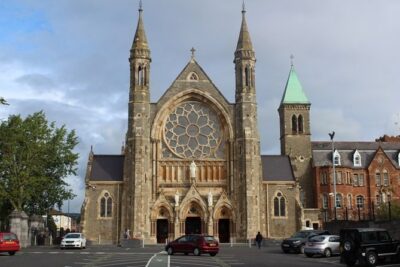
Clonard Monastery is a Catholic church and monastery off the Falls Road, home to the Redemptorists religious order. The tour frames Clonard as a front line location during the Troubles, sitting at an interface area between the Falls Road and Shankill Road districts.
You learn about Bombay Street and Cupar Street leading toward the Shankill Road, and how in August 1969 loyalist mobs attacked Catholic homes, forcing residents to flee and burning houses, including the whole of Bombay Street. The priests from Clonard are described as actively involved from the start in trying to safeguard local residents.
Two clergy names come up as important: Frs. Alec Reid and Gerry Reynolds lived at Clonard and worked for peace. That detail gives the site more than just conflict context, it ties it to ongoing peace-building efforts within the community.
Divis Tower and Ballymurphy Road, Concrete, Names, and Specific Murals
Later, you reach Divis Tower, which overlooks the Falls Republican stronghold. The tour notes that the British Army had a snipers nest and spy post there until 2005, so you get a literal view of how surveillance shaped daily life.
You also see the names and murals connected to the first two victims of the Troubles. That naming is important because the tour keeps pulling you away from generalities and back to people.
Then you go through Ballymurphy Road, where you see murals including An Gorta Mor, plus murals about local volunteers. One specific mural highlighted is Jim Bryson and his Big Louie machine gun, described as used to terrify British Army forces. You get a clear sense of how different stories take shape in paint and lettering.
The most interesting part here is that you are not just driving past scenery. You are being coached to read the city as evidence.
Pricing and Value, What You Get for $255.50
At $255.50 per person for about three hours, this is not the cheapest way to tour Belfast. Still, the value is strong if you care about context and access.
Here is what makes the math feel more fair:
- Private transportation and a driver who handles navigation, saving you time and stress
- Multiple stops where admissions are included, including museum and cemetery visits as described
- A private museum visit that is not usually open to the public
- The Peace Wall activity, including writing a peace message
- Additional access details included in the tour experience, such as seeing and handling plastic and rubber bullets used by British Crown forces
- The ability to ask questions throughout, which is a big deal when the subject matter is complex
If you only want a quick overview, this might feel like too much. If you want the Belfast Troubles story in a tight, guided, site-by-site format, you are paying for structure and access, not just driving around.
Who This Tour Fits Best (and Who Might Want a Different Angle)
This tour fits you if you:
- Want the Troubles explained from an Irish Republican perspective, with political analysis
- Like murals but want them decoded, not just photographed
- Prefer a private guide who can adapt to your questions as you go
- Are comfortable with memorial sites and the emotional reality of conflict history
It may not fit you as well if you:
- Want equal depth on every Loyalist argument and every British policy detail, since the tour is framed primarily through republican history
- Do not handle cemetery and memorial content well, because these stops are heavy and the tour packs a lot into a short timeframe
For what it is worth, the tour is often praised for guides who bring personal lived experience into the stories. Names that repeatedly show up in guide praise include Barry, Joe, Paula, Ciarán, Kieran, Brendan, and Brendon. That kind of narration can be a game changer, especially on topics where facts and emotions are tangled together.
Final Verdict: Should You Book?
I think you should book if your goal is an intense, guided, and very human Belfast Troubles experience in a short window. You are getting murals, Peace Walls, memorials, and a museum with private access, plus time to ask questions without crowd pressure.
Skip it only if you want a strictly balanced, two-sided debate style tour as the main product. This one is designed to give you the republican viewpoint clearly, then use the sites themselves to show how the division still shapes the city today.
If you do book, treat it like a serious learning walk. Dress comfortably, give your attention to the names and dates, and don’t rush the memorial stops. Belfast will do the rest.
FAQ
How long is the tour?
The tour lasts about 3 hours.
What does the price include?
The price is $255.50 per person and the tour includes admission tickets at the stops listed as included, plus private transportation in an air-conditioned vehicle.
Is hotel pickup included?
Free pickup is offered from a central Leonardo hotel meeting location. Pickup from other locations may cost extra, and there is no airport pickup or drop-off.
What are the museum hours, and what if it is closed?
The Irish Republican History Museum is open 10-2 Tuesday through Saturday. If it is closed, the tour will show you around Ballymurphy instead.
Is this a private tour or shared group?
This is a private tour/activity. Only your group participates.
Will I have time to write on the Peace Wall?
Yes. The tour includes visiting the Peace Wall where you can sign your name and write a message of peace.
Are tips included?
Tips for your guide are not included.
Put up recently for Belfast
- Game of thrones -Giants causeway luxury tour 9 hrs 25 locations★ 5.0 · 1 review
- Private One-way Transfer From Belfast Int. Airport to Belfast★ 5.0 · 1 review
- Enchanted Shores: Belfast to Giant’s Causeway★ 5.0 · 1 review
- CO2-Offset |Departure Belfast to BHD or BFS Airport by Luxury Van★ 5.0 · 1 review
- Belfast’s Iconic Sites: A Self-Guided Audio Tour★ 5.0 · 1 review
- SAY NOTHING 1 hr express taxi tour – The Troubles living history★ 5.0 · 1 review
Mural Tours, compared.
2 Hour Private Belfast Taxi Cab Tour of Troubles & Peace walls
Read our review →
Private Political History & Murals Tour Belfast
Read our review →
Giant’s Causeway and Belfast City Murals Tour inc Game of Thrones Dark Hedges
Read our review →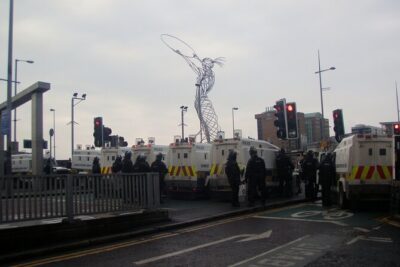
Belfast Troubles Murals Street Art and Peace Wall Walking Tour
Read our review →
Luxury Giants Causeway Tour in Mercedes + FREE Belfast Mural Tour
Read our review →Browse the lists this tour appears in